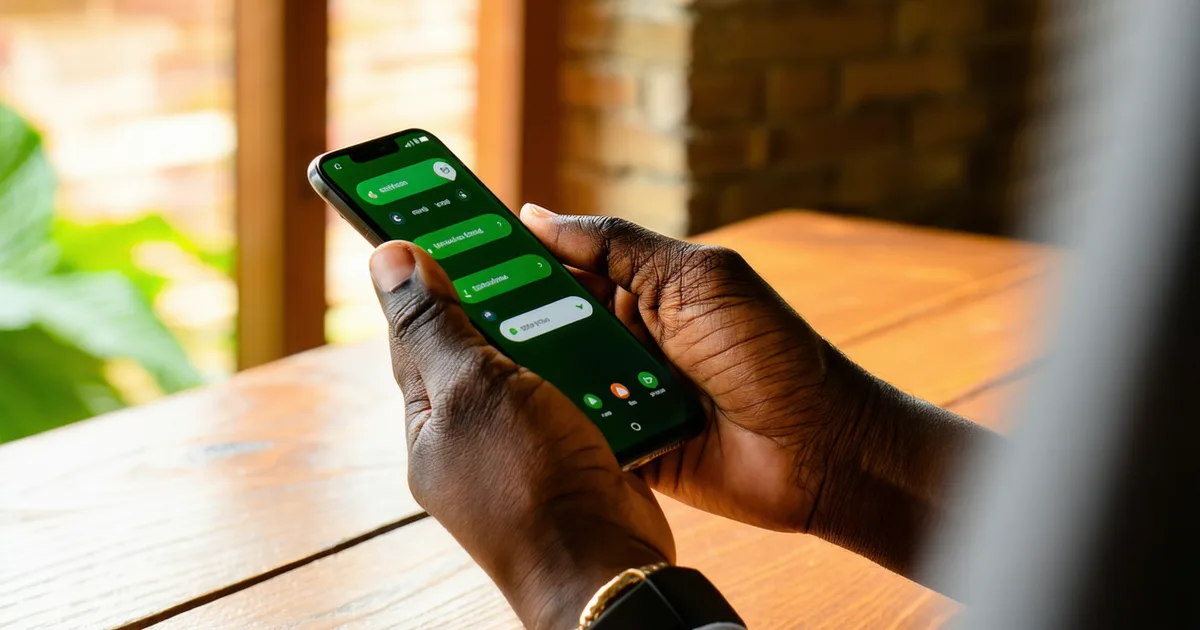
When we talk about digital health infrastructure in Sub-Saharan Africa, there is a tendency to imagine purpose-built apps, patient portals, and integrated electronic health records. These exist and they matter. But the actual communication channel that reaches the broadest cross-section of people across East Africa every single day is WhatsApp — and that fact has significant implications for how healthcare services should be designed.
Kenya alone has tens of millions of WhatsApp users. Across the continent, the platform's combination of free messaging over data, voice note functionality, and near-universal recognition among smartphone owners makes it the closest thing to a genuine mass communication infrastructure that currently exists for most of the population. Ignoring that when designing a health service is a product decision that limits who you can reach.
Why WhatsApp is not just a workaround
There is a default assumption in digital health circles that WhatsApp-based consultations are a stopgap measure — useful for markets where better infrastructure does not yet exist, to be replaced by more "sophisticated" tools as connectivity improves. We want to push back on that framing directly.
The people who message their family members, their tradespeople, their employers, and their local kiosks through WhatsApp every day are not choosing a second-best communication tool. They are using the tool that is convenient, familiar, available in their language, and already installed on their phone. The friction of using a purpose-built health app — creating a new account, verifying identity through an unfamiliar flow, learning a new interface — is real friction. WhatsApp has none of it.
This does not mean WhatsApp is the right channel for every clinical interaction. It is not. There are consultations that require structured data capture, full health records integration, or formats that a messaging interface handles poorly. We are not saying every health service should operate on WhatsApp. We are saying that reaching patients who are not already engaged with formal healthcare systems — which is much of the population in rural and lower-income urban contexts — requires meeting them where they already are.
How a WhatsApp health consultation actually works
The mechanics of a WhatsApp-based consultation are worth describing in some detail, because the practice varies considerably from one provider to another.
At one end of the spectrum, WhatsApp is used simply as a messaging channel — the patient types their symptoms, a practitioner reads the message and responds with advice, and the exchange looks more or less like a text conversation. This is low-friction but also low-structure, and it puts significant pressure on the practitioner to gather all the necessary information through unguided back-and-forth.
More structured approaches use the platform's voice note functionality as the primary input mode. A patient sends a voice note describing their symptoms, their medical history, and what they have tried so far. A practitioner listens, can ask follow-up questions by voice note or text, and provides guidance in a format that the patient can replay. Voice notes in particular suit patients who are more comfortable speaking than typing — a meaningful consideration in contexts where formal literacy in English or even Swahili may be limited.
At Zuri Health, a WhatsApp contact initiates a structured intake. The patient provides their name, age, and a description of what is bothering them. The platform routes the message to a practitioner who reviews the intake and continues the conversation, requesting more information where needed. The output is a care guidance document — prescription direction, referral if needed, or advice — delivered back to the patient through the same channel. Nothing in that flow requires the patient to learn anything new or create a new account.
Operator realities: data costs, session limits, and bandwidth
WhatsApp does consume mobile data, and data costs matter in East African markets where most users are on prepaid bundles. A voice note exchange consumes noticeably less data than a video call. Text messaging consumes less still. For a platform serving patients across both urban and rural Kenya, Uganda, and Rwanda, these differences are not trivial.
Consider a patient in a semi-rural area near Nakuru who tops up KES 50 worth of data at the start of the week. A ten-minute video consultation might consume their entire bundle. A WhatsApp exchange involving voice notes and text, covering the same clinical ground, might use a fraction of that. The practitioner conducting the consultation may never notice the difference. The patient absolutely does.
This is also why designing around asynchronous communication matters. Not every patient can hold a synchronous conversation — they may be in a place with poor signal, or mid-task, or unable to have a private conversation in their current environment. The ability to send a voice note, wait for a response, and engage across a 20-minute window rather than a live 20-minute call accommodates real-world access patterns that synchronous-only platforms cannot.
Privacy and data handling in a messaging context
The use of consumer messaging platforms for health communication raises legitimate questions about data privacy and record-keeping. These are serious questions that deserve direct engagement.
WhatsApp's end-to-end encryption means that message content is not accessible to the platform operator. This is a meaningful privacy protection for sensitive health conversations. It does not mean, however, that operating on WhatsApp is equivalent to operating on a purpose-built HIPAA-style secure messaging platform with full auditability, retention controls, and patient consent management built in.
Healthcare providers using WhatsApp as a consultation channel need to be clear with patients about what data is being held, where it is stored, and who can access it. Consultation notes that exist only in a WhatsApp thread, without being captured in a system of record, create continuity problems — the next practitioner a patient speaks to has no access to the previous consultation. Building a lightweight patient record alongside the WhatsApp channel, even if the channel itself is the primary communication surface, is a practice requirement rather than a nice-to-have.
At Zuri Health, WhatsApp is the patient-facing channel; the practitioner is working in a structured consultation interface that captures notes against the patient's record. The patient experiences a WhatsApp conversation. The practitioner has access to that patient's history. Both things are true simultaneously, and that architecture is what makes WhatsApp viable as a clinical channel rather than just a messaging one.
Practitioner experience and consultation quality
One of the more useful conversations we have had internally is about what practitioners find difficult about text and voice-based consultations compared to in-person ones. The honest answer is: quite a bit, when the consultation is not well-supported.
Without visual cues, practitioners rely entirely on what patients report. Patients are not always systematic reporters — they emphasise what feels most significant to them, which is not always what is most clinically relevant. Practitioners doing telephone and messaging consultations benefit significantly from structured intake protocols that prompt for key information: duration of symptoms, relevant history, medications currently being taken, any changes in the past few days. This reduces the back-and-forth needed to gather a usable clinical picture.
Practitioner training for asynchronous consultation also differs from in-person training. The skill of knowing when a situation requires escalation to a physical visit — and communicating that clearly to a patient who may be resistant to making the journey — is a specific competency. It is teachable, but it needs to be taught explicitly rather than assumed.
The broader shift in how patients engage with healthcare
What WhatsApp-based health services are exposing is something broader than a technology preference. Across East Africa, there is a generation of people who are deeply comfortable using digital messaging for consequential interactions — financial transactions via M-Pesa, legal disputes via group chats, business negotiations via voice notes. The idea that healthcare should be one of the few remaining domains that requires a physical visit for any interaction is, from their perspective, increasingly strange.
The challenge for digital health services is not getting patients to adopt new behaviour. It is recognising the behaviour that already exists and building quality clinical services on top of it. WhatsApp is already there. The question is whether the health system meets people on the platform they actually use, or continues to ask them to travel to a building to have a conversation that could have happened on their phone.
For many patients across Kenya and the wider region, the answer to that question determines whether they access care at all.